
Revenue-Based Financing: Helping Businesses Grow on Their Terms
For many entrepreneurs, accessing growth capital can be a challenge. Traditional loans often require collateral, while equity financing may require founders to give up ownership in the companies they've worked hard to build. Revenue-based financing (RBF) offers a different approach, providing capital with repayment terms that flex alongside a business's revenue.
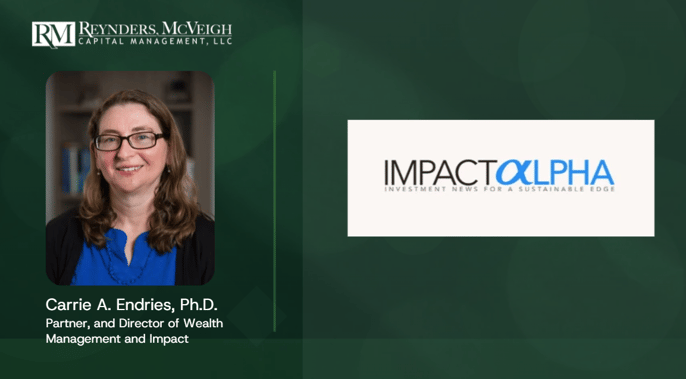
In a recent article for ImpactAlpha, Carrie Endries, PhD, Partner and Director of Wealth Management & Impact at Reynders, McVeigh Capital Management, explores how revenue-based financing can help support business growth while preserving ownership and creating opportunities for more inclusive wealth creation.
As Carrie notes: "RBF helps businesses grow on their terms at a pace that makes sense, rather than a pace forced by the investor cap table."
The article highlights how revenue-based financing can expand access to capital for entrepreneurs who may not fit traditional lending or venture capital models, while helping investors support business ownership, job creation, and long-term economic opportunity within local communities.
For additional perspective, read the full article: How revenue-based finance can help close the racial wealth gap
DISCLOSURES:
The views expressed reflect the current, good-faith opinions of Reynders, McVeigh Capital Management, LLC ("Reynders, McVeigh") at the time of publication and are subject to change without notice. This content is provided for informational and educational purposes only and does not constitute investment advice, a recommendation, or a solicitation to buy or sell any security.
References to specific investments — including Flex Capital Fund, Founds First Capital Partners, Coastal Enterprises, Inc., Boston Impact Initiative, and AltCap — are for illustrative purposes only and do not represent the full range of impact investments recommended by Reynders, McVeigh. Such impact investments should not be assumed to be profitable or suitable for all investors. Past performance is not indicative of future results.
Certain impact investments discussed may involve private offerings available only to accredited investors, may offer below-market returns, and may carry higher risk than publicly traded securities. Investment decisions should be based on each investor's individual financial situation, goals, and risk tolerance. Advisory clients should review all offering documents carefully and consult their portfolio manager regarding risks and suitability before investing.