
What Sustainability Analysis Reveals About 5 Mega - Cap Tech Firms
Key Takeaways
- AI success depends on more than capital investment: power access, water availability, regulatory approval, and local support are constraints that leaders in the AI race must contend with.
- Sustainability analysis reveals how companies are managing challenges, from Microsoft's rising emissions to Nvidia's geopolitical supply chain concentration.
- Our analysis surfaces the liabilities that can undermine returns and identifies the operating discipline that can help protect them.
U.S. tech giants earmarked more than $300 billion in 2025 for data centers and supporting infrastructure to meet anticipated AI demand. It’s a massive wager on AI’s future — one that could reshape markets for years to come. If these companies overspend, future returns could contract. If they underspend, they may lose ground to competitors.
AI capital expenditure commitments are only part of the story. The success of infrastructure spending hinges on access to power and water, regulatory approval, and local support. Just as important, the steps tech companies take to address these constraints signal resilience and execution discipline.
Sustainability analysis is how we assess whether companies are responding to these challenges. We combine quantitative and qualitative analysis to understand how businesses manage environmental, social, and governance responsibilities and whether they meet our long-term portfolio criteria. We want to see commitment, progress, and accountability.
How we review these companies
We turned our sustainability lens onto five prominent U.S. tech firms. Here’s a summary of what we found:
Microsoft
Risks:
Data center expansion driven by AI growth is contributing to a rise in Microsoft’s Scope 3 emissions (greenhouse gases produced throughout a company’s value chain). According to the company’s 2025 Environmental Sustainability Report, scope 3 emissions account for more than 97% of their total emissions, and have risen 26% since 2020. Data center expansion raises demand and risks around power, water, siting, and community approval. Microsoft’s AI and digital products carry ongoing privacy and security exposure, underscored by the June 2023 COPPA settlement related to the Xbox gaming platform.
Company response:
Microsoft aims to halve emissions and become carbon negative by 2030. Steps toward this goal include contracting 19 gigawatts (GW) of renewable energy in 2024, signing several nuclear supply agreements, efficiency programs, supply chain and carbon removal initiatives. The company is also targeting a 40% improvement in water efficiency to achieve water-positive operations by 2030 and provided 1.6 million people access to clean water in 2024. More recently, Microsoft launched its Community First AI approach, including commitments tied to local power pricing, water replenishment, and utility infrastructure upgrades near new data centers.
What we are watching:
- Whether Scope 3 emissions continue to rise as data center capacity increases
- The level of community and shareholder pushback on data center siting
- Whether AI governance evolves to mitigate misuse, privacy, and security risks
- Microsoft relies on the use of carbon credit purchases to make progress toward net zero goals. In 2024 the company applied 595,922 mtCO2e worth of credits which covered market-based scope 1 and 2 emissions. However, it did not cover the nearly 10 million tons of location-based scope 2 emissions it reported.
- As of 2024 Microsoft has purchased nearly 22 million tons worth of total carbon credits for current or future use. The company has also pledged to match energy consumption with renewable energy purchases, and in FY24 had contracted 34GW worth of renewable energy. These purchases are not in the same location as company emissions. However, carbon credit and renewable energy purchases make Microsoft one of the largest supporters of the renewable energy industry.
Our view:
Microsoft shows credible progress on emissions, water, and waste goals, alongside expanding disclosure and community commitments. We’ll continue to monitor whether governance and execution keep pace with the scale of its data center and AI expansion.
Nvidia
Risks:
Like Microsoft, Nvidia is feeling the pressure of surging worldwide adoption of AI. Its semiconductor chips are widely considered the solution to the data center energy bottleneck, and demand is driving rapid infrastructure build, raising power, water, and siting constraints. In its 2025 Sustainability Report, the company reported a 90% increase in its Scope 3 emissions as supply chain volumes increased. Supply chain concentration and geopolitical risk — particularly political tensions, trade restrictions, or conflict between countries — also present meaningful challenges. This is especially relevant for Nvidia, which relies on third-party foundries to manufacture its chips, with a significant portion of production concentrated in Taiwan. In addition, shareholders continue to press for tighter governance and disclosure.
Company response:
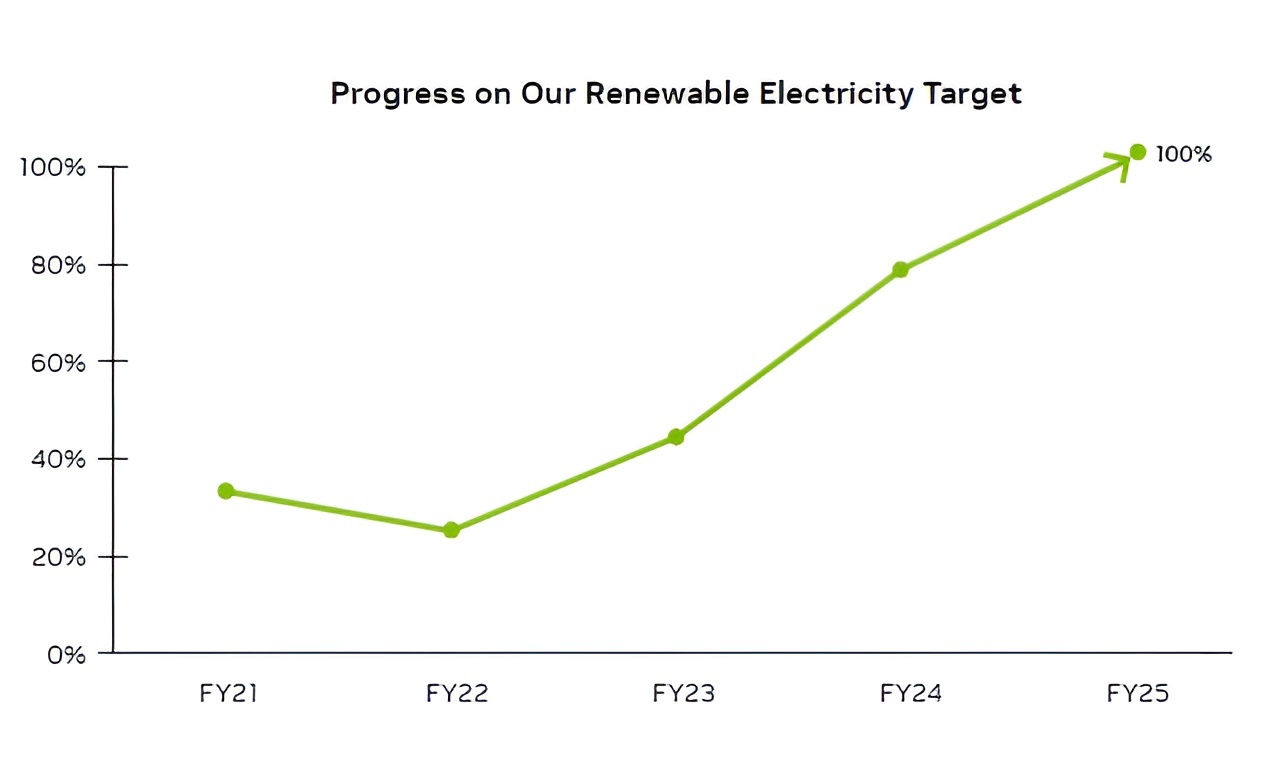
Nvidia reported 100% renewable electricity for the offices and data centers it operates. Its goal is to cut Scope 1 and 2 emissions in half by 2030 and reduce product-related Scope 3 emissions substantially. On the product front, its Blackwell GPUs are estimated to be more than 50x more energy efficient than traditional CPUs. The chipmaker is also improving AI disclosure through its open-sourced Model Card++ template, a framework designed to improve AI transparency, accountability, and ethics.
What we are watching:
- Scope 3 emissions trends alongside steadier supply chain growth
- Infrastructure constraints around power and water that may slow data center buildout
- Signs of demand volatility that could show up through circular financing
- Whether governance pressure increases as the company scales
- Scope 2 location-based emissions at Nvidia increased in FY25. The company does not rely on carbon credit purchases to offset these emissions. Instead, it matches its energy consumption with purchases of renewable energy. While these renewable purchases are not necessarily generated in the same locations as Nvidia’s emissions, the company’s nearly 780,000 MWh of renewable energy procurement represents meaningful support for the broader renewable energy industry.
Our view:
Nvidia is making considerable progress on energy sourcing, emissions targets, and responsible AI disclosure while emissions continue to rise during the company’s rapid growth.
Source: Nvidia Sustainability Report Fiscal Year 2025
Alphabet (Google)
Risks:
The story for Alphabet is familiar: AI acceleration is increasing the company’s energy and water needs. The scale of its user data creates material security, privacy, and reputation risk, especially as AI models expand. The company’s dominance in search and digital advertising exposes it to sustained antitrust pressure. Shareholders continue to challenge the firm’s dual-class voting structure and concentrated control (its co-founders maintain a voting majority).
Company response:
Alphabet has maintained a 100% renewable energy match on a global basis annually since 2017, according to company reports — and it’s asked suppliers to do the same by 2029. Data center emissions fell 12% in 2024 despite a 27% increase in energy consumption, and 35% of its owned and operated data centers met zero waste targets in 2024. The company is using treated wastewater and stormwater storage to reduce pressure on local water supplies and has strengthened AI safeguards aimed at reducing harmful content, data leakage, and misuse.
What we are watching:
- Whether energy and water constraints tighten as data centers grow
- Antitrust actions and potential remedies that could alter the company’s business model
-
Whether AI governance and security controls keep pace with risk, and if investor pressure on dual-class governance rises.
- Alphabet’s net zero goals rely on carbon credit purchases. In 2024 it purchased almost 800K tons of carbon removal credits.
Our view:
Alphabet shows measurable progress on energy sourcing, emissions intensity, and waste reduction while facing persistent regulatory and governance scrutiny. The durability of its sustainability will be tested by how well it executes through this phase of AI and data center growth.
Amazon
Risks:
Amazon’s carbon footprint increased 6% in 2024 as AWS and AI services expanded, according to its 2024 Sustainability Report. It faces persistent regulatory and legal exposure, highlighted by the September 2025 FTC settlement over Prime enrollment and cancellation practices. The company remains under scrutiny for workplace conditions and safety, and it carries ongoing data security and antitrust risk. Shareholders continue to push for stronger governance, labor oversight, and climate disclosure.
Company response:
Amazon is the largest corporate purchaser of clean energy and has set a 2040 net zero goal. It cut carbon intensity by 4% in 2024 even as total emissions rose. Although it does not disclose its total water usage Amazon reports being 53% of the way toward AWS’s goal of becoming water positive by 2030. The company pledged $1.2 billion in September 2021 to upskill workers, and reports that by October 2025 it had trained more than 700,000 worldwide, including 425,000 in the U.S. It added more than 30,000 EVs to its delivery fleet in 2024 and aims to reach 100,000 by 2030.
What we are watching:
- Absolute emissions as AI and cloud growth continue
- Workplace safety trends amid ongoing scrutiny
- The direction of regulatory and antitrust actions
- Whether shareholder pressure on governance and disclosure intensifies. This is especially relevant after recent proposals at the company’s annual meeting called for greater transparency on how it plans to meet its climate commitments as AI and data center demand grow.
- Amazon purchases carbon credits in a practice it calls “carbon neutralization.” The company estimates less than 5% of carbon credits on the marketplace meet the quality bar it has set. It also matches electricity consumption with renewable purchases. As of 2024, Amazon had invested in over 600 renewable energy projects, which will generate more than 30GW of annual capacity once operational.
Our view:
Amazon shows measurable progress on clean energy procurement, efficiency, and water targets, while infrastructure and scrutiny continue to rise with AWS and AI growth. Further commitments to governance and warehouse working condition improvements would strengthen sustainability.
Tesla/SpaceX
Risks:
Key risks for Tesla are of a different nature than those outlined for the other four companies. Although Tesla and SpaceX are technically run as separate companies, governance and key-person risk remain central, given CEO Elon Musk's influence at both companies and his commitments outside each business. Tesla has faced recurring shareholder scrutiny on several issues including board independence, CEO compensation, and arbitration practices, alongside controversy risk from Musk’s public statements and conduct. Additional liabilities include environmental and regulatory exposure tied to SpaceX launch frequency, emissions, and the growing debris and collision risk from its satellite fleet.
Company response:
Tesla has advanced the global adoption of EVs and is a leader in the development of autonomous vehicles. It continues to expand its charging network and has opened it to other vehicle manufacturers. The company is also growing its clean energy generation and storage business. Meanwhile, SpaceX is pioneering reusable rocket technology, positioning itself as a launch provider for partners that could include space-based solar power providers. It is also updating satellite designs to reduce light pollution and debris.
What we are watching:
- The effectiveness of governance reforms in strengthening board independence and reducing related party concerns
- Regulatory constraints and environmental litigation that may limit SpaceX launch frequency
- Whether disclosure improves as investor interest and scrutiny build ahead of a potential SpaceX IPO
- Tesla is a seller of carbon credits, which it calls Automotive Regulatory Credits. The sale of these credits peaked in 2024, bringing in $2.7B in revenue for the company, but fell to just under $2B in 2025.
Our view:
Tesla’s sustainability credentials rest on the impact of its core products in transport electrification and energy systems. Those credentials are weakened by governance and key person risk. SpaceX adds an additional layer of regulatory and environmental uncertainty.
What standard financial analysis often overlooks
Big tech firms are resource-intensive and complex, but their scale and innovation capacity give them the power to drive real progress — or spectacular failure. Our sustainability analysis is designed to surface the liabilities that can undermine returns and identify the operating discipline that can protect them.
One example is how we assess corporate emissions. Many companies report both market-based and location-based Scope 2 emissions, which measure indirect emissions from purchased electricity. Market-based reporting allows companies to adjust emissions figures through renewable energy purchases and other clean-energy contracts. These initiatives are important and we strongly encourage continued investment in renewable projects. However, market-based reporting can obscure the local environmental impact of operations.
Location-based reporting instead reflects the emissions intensity of the actual power grid where a facility operates, offering a clearer view of how company operations affect surrounding communities. For example, a company could operate a production facility in Alabama and offset its electricity consumption with solar purchases from California. While the solar investment supports renewable energy development, the local facility may still rely on coal-generated power from the regional grid, meaning the surrounding community continues to experience the environmental effects of that generation.
Looking at both measures helps us understand the full picture. When we evaluate these companies rigorously and transparently, we're able to monitor progress on emissions, water, governance, and disclosure. But we're also watching for the warning signs: rising emissions, governance gaps, regulatory pressure, and infrastructure constraints. The firms that navigate these challenges successfully won't just survive the AI boom, they'll define it. We believe understanding those distinctions is what drives long-term returns.
DISCLOSURE: This paper is for informational purposes only and does not constitute investment advice or a recommendation to buy or sell any security. The companies referenced herein are provided as examples of companies that Reynders, McVeigh Capital Management, LLC (“the Firm”) believes demonstrate positive sustainability practices. The inclusion of these examples does not reflect all of the securities purchased, sold, or recommended for advisory clients, and it should not be assumed that any investments in these securities were or will be profitable.
The Firm is a registered investment adviser. Registration with the U.S. Securities and Exchange Commission does not imply a certain level of skill or training. This paper is not intended to be a solicitation or offer to buy or sell any securities or related financial instruments.
Any performance data or sustainability-related commentary contained herein is provided for illustrative purposes and should not be relied upon as a forecast or guarantee of future results. Investing involves risk, including the potential loss of principal. Clients and prospective clients should consult with their adviser regarding their specific investment needs and circumstances.
All information is obtained from sources believed reliable, but accuracy and completeness cannot be guaranteed. The Firm assumes no obligation to update any information contained herein. By clicking on hyperlinks, you are leaving the Firm website and entering a third-party site. The Firm is not responsible for information contained on the third-party sites.